Frequency Smugglers: The Underground Producers Hiding Psychedelic States Inside Your Work Playlist
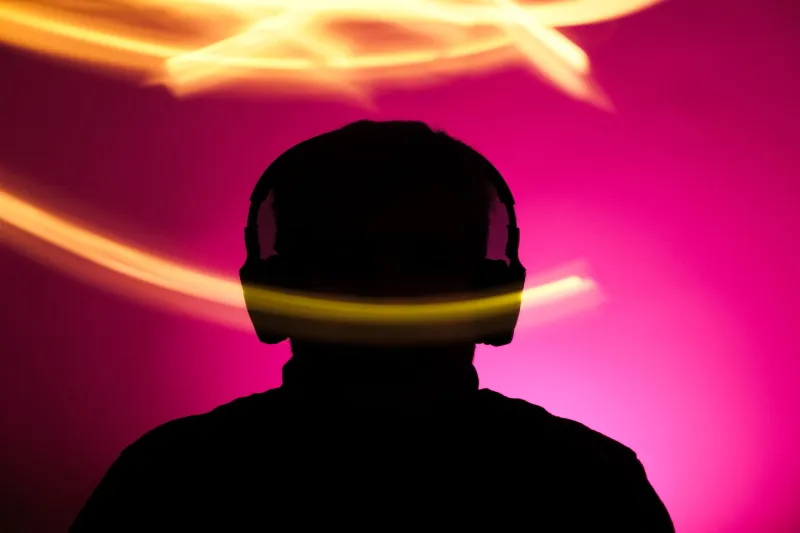
You think you're just vibing to lo-fi hip-hop while you grind through a Tuesday afternoon. Maybe it's raining outside. Maybe you've got a deadline. You hit play on some ambient study mix, and somewhere around the forty-minute mark, something shifts. The spreadsheet starts to feel almost interesting. The noise of the open office fades. You're not high, exactly. But you're not entirely here, either.
That's not an accident.
A loose, largely anonymous network of underground producers has spent the better part of a decade quietly embedding binaural beat frequencies into music that looks — on the surface — completely innocuous. Focus music. Meditation soundscapes. Lo-fi chill beats. The kind of stuff that gets licensed by productivity apps, uploaded to YouTube under vague titles like "Deep Work 432hz 8 Hours," and streamed by millions of people who couldn't tell you what a binaural beat is if their annual review depended on it.
Welcome to the accidental psychedelic underground. Population: your entire office.
What's Actually in Your Ears
Binaural beats aren't new. The phenomenon was first documented in 1839 by Prussian physicist Heinrich Wilhelm Dove, who noticed that when two slightly different frequencies are played separately into each ear, the brain perceives a third, phantom beat — the difference between the two. Play 200 Hz in your left ear and 210 Hz in your right, and your brain manufactures a 10 Hz tone that doesn't exist in physical reality.
Depending on the frequency of that phantom tone, researchers have associated different neural effects. Delta waves (1–4 Hz) are linked to deep sleep. Theta (4–8 Hz) to dreaming and hypnagogic states. Alpha (8–13 Hz) to relaxed focus. Gamma (above 30 Hz) to heightened perception and, in some studies, experiences that participants describe as — and there's no cleaner way to say this — tripping a little.
The science is real. The interpretation is contested. And the producers exploiting the gap between those two facts are having the time of their lives.
The Algorithm Is the Distribution Network
"I figured out around 2019 that if you title something right and bury the frequency work deep in the mix, YouTube's algorithm will do the rest," says a producer who goes by Mosswave and operates out of a basement studio in Akron, Ohio. He asked us not to use his full name. Not because what he's doing is illegal — it isn't — but because, as he puts it, "the mystery is part of the product."
Mosswave's channel has accumulated over twelve million total plays. His most popular upload, a three-hour ambient piece with theta-range binaural tones woven beneath layers of granular synthesis and field recordings, sits at 4.2 million views. The comments read like dispatches from a group therapy session: I fell asleep and had the most vivid dream of my life. I cried and I don't know why. I listened to this during my lunch break and felt like I was underwater in the best possible way.
He's not alone. Producers like Silt Garden (Portland), Pale Antenna (rural Vermont), and the mysterious collective known only as Null Meridian have built substantial followings doing variations on the same thing — layering frequency-based neurological nudges beneath music that passes the vibe check for corporate playlist approval.
"The joke," Mosswave says, laughing, "is that HR-approved focus music is now the most psychedelic thing on the internet."
The Neuroscientists Who Can't Quite Explain It
Dr. Renata Solís, a cognitive neuroscientist at a mid-sized research university in the Pacific Northwest who studies auditory processing and altered states, is careful with her language when discussing binaural beats. "The effect is real," she says. "We can measure the frequency-following response in EEG data. The brain does entrain to these phantom tones. What we cannot say with confidence is exactly what that entrainment does to subjective experience at scale."
She's published two papers on the topic and is currently running a study on theta-frequency exposure during creative tasks. When we mention the underground producer community deliberately embedding these frequencies into streaming content, she pauses.
"That's... actually a fascinating natural experiment," she says. "Millions of subjects, zero informed consent forms. I'm not sure whether to be horrified or intrigued."
She settles on intrigued. Cautiously.
The honest answer from the neuroscience community seems to be: something is happening, we're not sure of the mechanism, and the anecdotal evidence from millions of listeners is too consistent to dismiss. People report reduced anxiety, heightened creativity, and — in the case of gamma-range content — occasional experiences that blur the line between focused flow state and something considerably more untethered.
Stealth Psychedelics and the Ethics of Invisible Influence
Not everyone in the underground frequency scene is comfortable with the covert approach. A producer named Delia Voss, who releases under the name Chlorophyll Static from her home studio in Taos, New Mexico, has started including explicit disclosures in her video descriptions — noting the specific binaural frequencies used and their intended effects.
"I believe in the work," she says. "I think these frequencies can genuinely help people access states that are healing, creative, expansive. But I want people to choose that. I want them walking through the door consciously, not getting shoved through it while they're trying to finish a PowerPoint."
It's a legitimate tension. The producers gaming the algorithm are, in one reading, democratizing access to altered states for people who'd never seek them out intentionally — office workers, students, suburban parents — dissolving the gatekeeping that usually surrounds psychedelic experience. In another reading, they're running an experiment on millions of people without disclosure.
Mosswave doesn't lose sleep over it. "Nobody consents to the frequency of fluorescent lights," he says. "Nobody consents to the anxiety that comes from a 24-hour news cycle. I'm just putting something gentler in the stream."
The Movement Has Its Own Aesthetics
What's emerged from this scene isn't just a production technique — it's a full aesthetic universe. Album art tends toward the organic: moss, water, soft light, mushrooms, the textures of things that grow slowly. Titles are deliberately vague and slightly mystical. The music itself occupies a deliberate no-man's-land between ambient, lo-fi, and new age — familiar enough to not alarm anyone's playlist algorithm, strange enough to do its work.
There are Discord servers. There are Reddit threads where listeners compare experiences with the precision of psychonauts cataloging trip reports. There are producers who communicate exclusively through encrypted channels and release music anonymously to avoid any association with the more commercialized end of the "wellness music" industry.
It's an underground scene hiding in the most mainstream distribution channels on earth. And every day, without knowing it, millions of people are tuning in, dropping slightly out, and turning — just a little — inward.
That's the trip. And you're already on it.