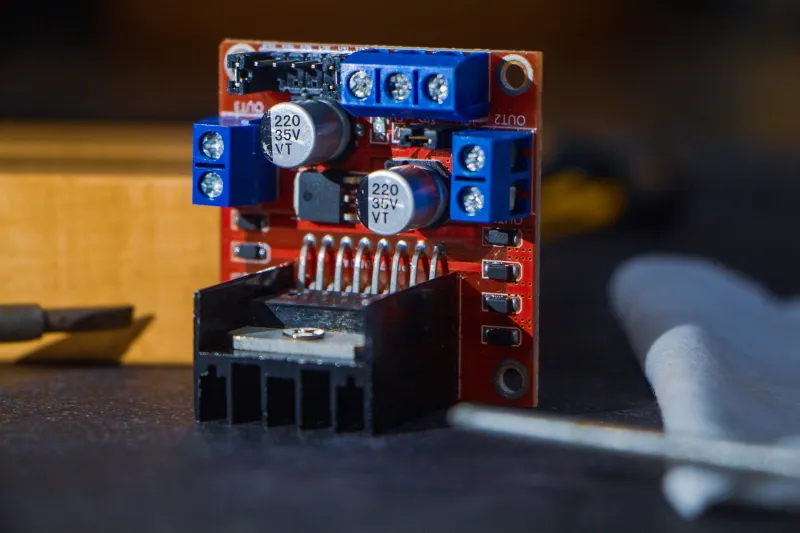
Broken and Beautiful: The Circuit Benders Who Summon Spirits From Dead Machines

There's a Casio SK-1 on a workbench in a Portland basement that hasn't made a factory-approved sound in eleven years. Its case is cracked, its keys are yellowed, and somewhere inside its circuit board a capacitor blew out during a particularly intense session involving copper wire, alligator clips, and what its owner, who goes by the name Vessel Rot, describes only as "an honest conversation with the machine."
Vessel Rot doesn't fix broken gear. He negotiates with it.
"Every piece of dead equipment has a frequency it was trying to reach before it got locked into commercial production," he says, poking at a tangle of patch points he's soldered directly onto the SK-1's main board. "My job isn't to restore it. My job is to finish what it started."
This is circuit bending — but not the YouTube tutorial kind. What's happening in basements and loft studios across the US is something altogether stranger and more committed. A loose, decentralized network of experimental musicians and sound artists is pushing hardware modification into genuinely fringe territory, blending the technical with the ritualistic, treating obsolete electronics not as salvage but as something closer to sacred objects in need of awakening.
The Body of the Machine
Circuit bending as a practice goes back to the late 1960s, when Reed Ghazala accidentally shorted out a toy amplifier and discovered that the resulting sounds were more interesting than anything the device was designed to produce. The technique spread slowly through the experimental underground, finding its people in noise musicians, avant-garde composers, and anyone with a low budget and a high tolerance for unpredictability.
But the contemporary wave isn't just about finding weird sounds. It's about a philosophy of the instrument — the idea that mass-produced electronics are fundamentally suppressed, built to stay inside narrow sonic corridors, and that physical intervention is the only way to liberate what's actually in there.
"The factory setting is a cage," says Mara Silt, a Chicago-based sound artist who works exclusively with equipment she finds in thrift stores, estate sales, and what she calls "curb archaeology" — dumpster diving for dead gear. "When a machine breaks down, the cage opens. That's when it gets interesting."
Silt's process involves what she describes as a period of listening before any tools come out. She'll power up a damaged piece of hardware, record whatever it emits — hum, static, the occasional accidental tone — and study those recordings for days before making a single modification. She's looking, she says, for the machine's "existing voice" before she starts amplifying it.
"People think I'm being weird about it," she laughs. "But if you're going to intervene in something's nervous system, the least you can do is listen first."
Ritual and Resistance
The occult framing that runs through this scene isn't purely metaphorical, and it's worth taking seriously on its own terms. Several artists in this orbit are explicit about treating modification sessions as rituals — specific environments, specific lighting, sometimes specific timing tied to lunar cycles or personal significance.
Drez Hollow, a Brooklyn-based noise composer who releases on a handful of micro-labels and maintains a deliberately minimal online presence, describes his modification practice as inseparable from his broader spiritual life.
"I grew up in a household that took animism seriously," he says. "The idea that objects accumulate energy, that they hold memory — that's not a metaphor for me. When I open up a synthesizer that's been sitting in someone's attic for thirty years, I'm not just looking at circuits. I'm reading a history."
Hollow's modifications tend to be minimal by the standards of the scene — he's less interested in radical transformation than in what he calls "releasing pressure." A carefully placed short here, a bypassed filter stage there. The goal is to find the frequency the machine has been building toward and give it an exit.
The results, on record, are genuinely unsettling in the best possible way. His recent release Corrosion Psalms — twelve tracks built entirely from a single dead Yamaha DX7 — sounds like transmissions from a dimension adjacent to this one. Metallic, spectral, alive in ways that polished synthesis simply isn't.
Why Broken Gear Sounds Better
There's actual science underneath the mysticism, and it's worth acknowledging. Damaged electronics behave nonlinearly — they clip, fold, and saturate in ways that introduce harmonic complexity impossible to replicate with intact circuits. A capacitor that's leaking DC voltage will distort audio in ways no plugin can convincingly model. Corroded contacts create resistance variations that act like crude, unpredictable filters.
In other words: the imperfection is the point.
"Clean gear is boring gear," says Toni Fuse, a Los Angeles-based producer who works at the intersection of experimental electronic music and hardcore punk. "Every pristine synthesizer sounds like every other pristine synthesizer. Give me something that's been through it. Give me a machine with scars."
Fuse's studio is a controlled chaos of half-modified keyboards, exposed circuit boards, and what appears to be a Speak & Spell that has been subjected to experiences no child's toy should survive. Her process is more aggressive than Hollow's or Silt's — she's less interested in listening to the machine and more interested in stress-testing it until something unexpected happens.
"I'm not gentle," she admits. "I'm looking for the moment where the machine stops doing what it's supposed to do and starts doing something it invented on the spot. That's the sound I want."
The Ethics of the Graveyard
Not everyone in the broader experimental community is enthusiastic about this approach. Vintage gear collectors — a significant and sometimes territorial subculture — tend to view circuit bending with something between suspicion and open hostility. Every modified Minimoog is a Minimoog that can't be restored. Every Juno-106 with alligator clips soldered to its voice chips is, from one perspective, a piece of history that's been permanently altered.
Vessel Rot has heard this argument and is unmoved.
"Museum culture around old gear is a kind of death worship," he says. "You're preserving the corpse and calling it respect. I'd rather the machine be alive and different than dead and pristine."
It's a tension that maps onto broader arguments in the experimental music world about preservation versus transformation, reverence versus use. And it probably doesn't have a resolution — which is fine. Good arguments in music rarely do.
The Frequency That Was Always There
What unites these artists, despite their different approaches and philosophies, is a shared conviction that the sounds they're finding were always present in the equipment — latent, waiting, locked behind factory specifications and commercial logic.
Circuit bending, in this reading, isn't destruction. It's excavation.
"I've heard frequencies come out of a thirty-dollar thrift store keyboard that I've never heard anywhere else," Mara Silt says, wrapping up a session with a newly acquired dead Casiotone. "Nobody programmed those frequencies. Nobody intended them. But they were in there."
She powers the machine on. It hums, stutters, produces a sound like a whale calling from the bottom of a digital ocean.
"See?" she says. "It just needed someone to ask."
Got a broken machine with something to say? Tell us about it — we want to hear what you're finding in the graveyard.