Plug-Free and Proud: The Underground Musicians Building Music Rigs That Laugh at the Power Grid
There's a certain kind of producer who doesn't flinch when the lights go out. Not because they've got a generator humming in the garage — though some definitely do — but because their entire setup was designed from the jump to run without the comfort of a wall socket. No utility company. No surge protector prayers. No moment of panic when the breaker trips mid-session.
These are the synth preppers. And they're quietly becoming one of the more fascinating subcultures living inside the already-weird world of experimental and underground music.
The Grid Is a Leash
Let's be honest: the counterculture has always had a complicated relationship with infrastructure. Psychedelic culture, going back to its earliest American incarnations, was suspicious of systems — corporate systems, political systems, the kind of invisible architecture that tells you where to plug in, what to consume, and how loud you're allowed to be.
For a lot of underground musicians, the power grid is just one more system asking for obedience. And some of them are done complying.
"The grid is just another subscription service," says Theo, a modular synthesizer builder and experimental ambient artist based outside of Taos, New Mexico, who asked that we use only his first name. "You're renting access to your own creative output every time you plug something in. I wanted to own the whole chain."
Theo spent three years gradually converting his studio — a converted horse trailer on a half-acre of high desert — to run entirely on solar. His modular rig pulls from a 400-watt panel array and a lithium battery bank he assembled himself from salvaged EV cells. On a good sun day, he can run sessions for 14 hours without drawing from storage. On a cloudy New Mexico afternoon, he's still got enough juice for a six-hour drone set and a full render.
Solar, Crank, and Everything In Between
The tools these builders are using aren't exotic — they're just applied differently than most musicians think to apply them. Portable solar panels from Jackery and Goal Zero, originally marketed toward van lifers and weekend campers, have become legitimate studio power sources for producers willing to do the math on wattage and load. A small Eurorack setup, a laptop running Ableton or Bitwig, and a pair of studio monitors can often be powered indefinitely on a mid-range solar rig once you optimize everything.
Others go more analog. Marta Fuentes, a Chicago-based noise artist and sound installation builder, has been performing with a setup that includes a hand-cranked dynamo connected through a custom voltage regulator to a small bank of semi-modular synths — a Moog Werkstatt, a Bastl Kastle, and a few custom-built oscillators she designed herself.
"People think it's a gimmick," she says, laughing. "And yeah, there's definitely a performative element to cranking your own power on stage. But it genuinely changes the music. The voltage fluctuates slightly depending on how fast you crank. Those fluctuations become part of the composition."
That instability — the wobble, the drift, the slight unpredictability — is something these artists actively embrace rather than engineer around. It's a philosophy that rhymes deeply with psychedelic culture's comfort with chaos, with letting go of control and seeing what emerges.
Offline DAWs and the Death of the Cloud
The off-grid ethos doesn't stop at power. A growing number of underground producers are also severing their dependence on cloud-based software, subscription plugins, and internet-connected tools. The move toward offline DAW setups — fully licensed, locally stored, requiring zero connectivity — is partly practical and partly political.
"I had a session get killed because my iLok license server timed out," says Portland-based producer and psychedelic hip-hop beatmaker known online as Sundial Wraith. "I'm in the middle of something that feels alive, and some server in a data center decides I don't exist anymore. That's insane. That's not a creative environment."
Sundial Wraith now runs a fully offline setup on a refurbished ThinkPad — perpetual license DAW, locally stored sample libraries totaling nearly four terabytes, and a small collection of hardware synths and drum machines that need nothing from the internet to function. The whole rig fits in a backpack. He's recorded tracks in parking lots, on hiking trails, and once, memorably, during a power outage at a friend's warehouse in Southeast Portland while the rest of the party stood around on dead phones.
"That's when I realized I'd actually done it," he says. "Everyone else was stranded. I just kept making music."
Survivalism Meets Psychedelia
It would be easy to frame this as paranoid behavior — and sure, some of these folks aren't shy about their concerns regarding infrastructure fragility, climate disruption, and the general chaos of the current decade. But the vibe in these communities isn't fear-forward. It's more like a very calm, very deliberate middle finger to dependency culture.
Psychedelic traditions have long emphasized ego dissolution — the shedding of false structures, the recognition that the systems we take for granted are constructions, not inevitabilities. Building a music rig that doesn't need the grid is, in a very literal sense, an act of that same dissolution. You're stripping away an assumed dependency and finding out what's actually underneath.
Theo puts it this way: "When you're on a good trip, you realize how much of your life is just borrowed infrastructure. Your apartment, your internet, your electricity — you're renting all of it. Making music that doesn't need any of that feels like... I don't know. Like actually owning something real."
Building Your Own Escape Hatch
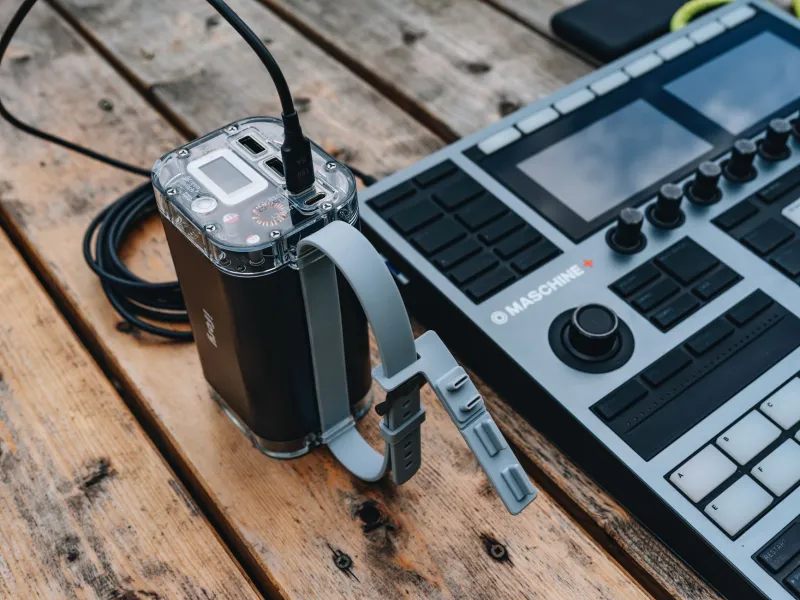
For musicians curious about moving in this direction, the entry points are more accessible than you'd think. A 100-watt portable solar panel and a mid-range power station can run a basic Eurorack or semi-modular rig for hours on a sunny afternoon. Apps like Drambo or AUM on iPad, paired with a good audio interface, create a shockingly capable portable studio that can run on battery alone. Going fully offline with a DAW is mostly a matter of planning — buying perpetual licenses, downloading everything locally, and auditing which plugins phone home.
The more ambitious builds — the converted trailers, the custom dynamo rigs, the multi-panel arrays — take time and money and a tolerance for learning things outside your comfort zone. But that's sort of the point, isn't it?
The underground has always been about building your own thing because the existing thing wasn't built for you. Whether that's a record label, a venue, a distribution system, or a power source — the DIY instinct is the same one that's driven experimental and psychedelic music since the whole trip began.
The grid was never really yours anyway. Might as well make music without it.