Red Frequency: The Underground Obsessives Turning Cold War Lab Junk Into Tomorrow's Weirdest Instruments
Somewhere in a warehouse outside of Kyiv, stacked between decommissioned centrifuges and dusty reel-to-reel tape decks, sits a Soviet-era electroencephalograph that once measured the brain waves of cosmonauts. It's not headed to a museum. It's headed to a bedroom studio in Portland, Oregon, where it's going to be gutted, rewired, and coaxed into producing sounds that no synthesizer manufacturer ever dreamed of.
This is the world of Cold War instrument salvage — and it's quietly becoming one of the most fertile frontiers in underground music.
The Surplus Trail
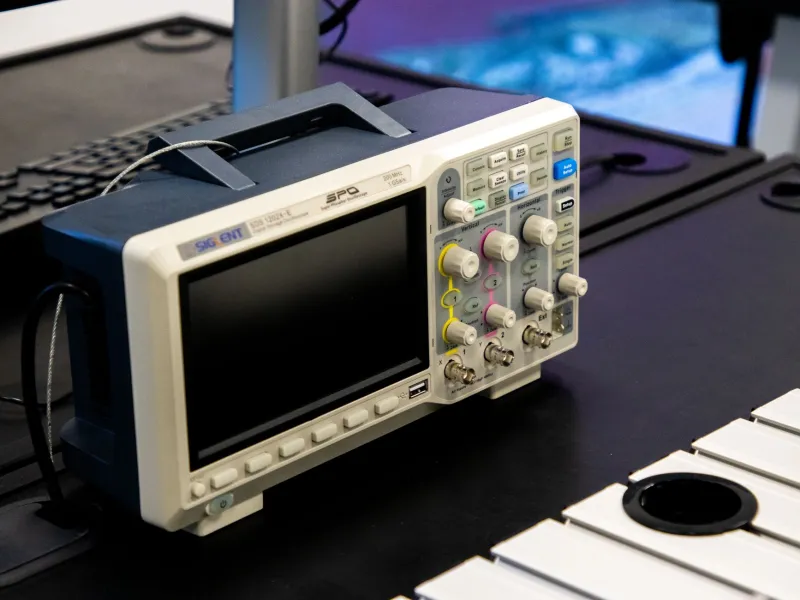
The pipeline starts in places most American musicians have never heard of. Online surplus markets based in Poland, Ukraine, and the Czech Republic have become gold mines for a specific kind of obsessive — the type who reads circuit diagrams for fun and considers a soldering iron a primary instrument. These platforms sell off the material remnants of Soviet-era scientific and military infrastructure: signal generators, function oscillators, medical EEG units, ultrasonic therapy devices, military-grade frequency counters, and lab equipment whose original purpose is sometimes genuinely difficult to determine even with a translation app.
Shipping costs are brutal. Documentation is sparse. And the equipment often arrives in states that range from "dusty but functional" to "this might have been in a flood." None of that is stopping the people who want it.
"You're not buying a piece of gear," says Marcus Thiel, a Denver-based sound designer who has been sourcing Eastern Bloc lab equipment for about four years. "You're buying a mystery box full of engineering decisions made by people working under completely different assumptions about what electronics are for. That's where the interesting stuff lives."
What Makes the Sound Different
The sonic character of Soviet-era lab equipment is difficult to describe without resorting to words that sound like drug trip notes — which, honestly, fits the audience just fine.
Where Western commercial synthesizers from the same era were engineered toward musicality, toward smooth oscillation curves and predictable filter responses, Soviet scientific instruments were built for precision measurement and signal analysis. The oscillators in a function generator from a 1970s Moscow laboratory weren't tuned to sound pleasing. They were tuned to be accurate. And when you run audio through circuits that were designed with that kind of ruthless, utilitarian logic, you get something that doesn't sound like any synthesizer you've ever touched.
Thiel describes the output of a modified Soviet medical signal generator he uses regularly as "like a Moog that grew up in a nuclear bunker and never learned to be polite." The waveforms are raw in ways that digital modeling can't fake. The noise floors carry a kind of geological weight. Filters behave in ways that Western circuit design would have considered defects.
Those "defects" are the whole point.
The Modification Layer
Most of this equipment doesn't arrive plug-and-play, and even when it technically functions, it functions for purposes that have nothing to do with music. The modification process is where things get genuinely creative — and genuinely dangerous if you don't know what you're doing.
Common modifications include adding CV input jacks so the equipment can talk to modular synthesizers, installing audio output stages where none existed, replacing or bypassing internal voltage regulators to introduce instability, and adding manual controls to parameters that were originally only adjustable through internal calibration. Some builders go further, combining multiple pieces of equipment into hybrid instruments that exist nowhere in any product catalog.
Lila Voss, a Chicago-based experimental producer who performs under the name Ferrite, spent eight months converting a Soviet-era ultrasonic therapy unit into a drone instrument. The device was originally used to apply therapeutic vibrations to patients' joints. Now it generates subsonic and near-subsonic frequencies that she layers into compositions that feel less like music and more like pressure changes in a sealed room.
"The original engineers built in these really specific harmonic characteristics because they needed the ultrasound to penetrate tissue in a particular way," she explains. "I'm using those same characteristics to make music that gets inside people differently than normal sound does. It's the same physics, completely different context."
Countercultural Hardware
There's an obvious ideological dimension to all of this that the people involved are happy to talk about. In an era when Western music gear is increasingly dominated by a handful of major manufacturers — when the same soft-synth presets are showing up in tracks from Brooklyn to Los Angeles — reaching for equipment that was engineered entirely outside that commercial ecosystem feels like a genuine act of resistance.
Soviet scientific instruments weren't designed to sell. They weren't designed to appeal to a market. They were designed to function within a completely different set of economic and ideological assumptions. That makes them weird in ways that money can't manufacture.
"You can't buy this sound," says Thiel. "You can't download a plugin that sounds like this. You have to find the thing, figure out what it does, figure out how to make it do something else, and then figure out how to make music with it. That process is part of the music."
The community around this practice is small but genuinely global. Forums dedicated to Eastern Bloc electronics attract contributors from across the US, Europe, and beyond, sharing circuit diagrams, translation help for Cyrillic technical manuals, and modification guides for specific pieces of equipment. It has the energy of early DIY synthesizer culture — the sense that a small group of people who are willing to do the work are accessing something genuinely new.
The Ethics of the Dig
It would be incomplete to talk about this practice without acknowledging that some of this equipment has complicated histories. Medical devices that treated patients. Military equipment that served authoritarian systems. Lab gear that may have been used in programs whose ethics were questionable at best.
Most of the musicians involved in this world are aware of that weight and choose to sit with it rather than ignore it. Voss frames her use of the ultrasonic therapy unit as a kind of transformation — taking something that operated within a specific historical context and redirecting its physical properties toward something entirely different. "I'm not erasing where it came from," she says. "I'm adding a new chapter."
Where This Goes
The supply of Cold War-era Eastern European lab equipment is finite. Surplus markets are thinning out. Prices that were laughably low five years ago are climbing as more people catch on. Some of the most interesting pieces are already gone, absorbed into private collections or simply disintegrated past the point of recovery.
But the knowledge being built around these instruments — the modification techniques, the circuit understanding, the sonic vocabulary — isn't going anywhere. It's feeding back into the broader DIY electronics community, influencing the way people think about what sound-making equipment can be and where it can come from.
The best music gear was never the most expensive or the most marketed. It was always the stuff that made sounds nobody planned for. Right now, that stuff is sitting in a warehouse outside of Kyiv, waiting for someone with a soldering iron and a very high tolerance for uncertainty to give it a second life.
Plug in. Tune to the frequency nobody designed.