Touch the Sound: How Blind Producers Are Rebuilding the Studio From the Inside Out
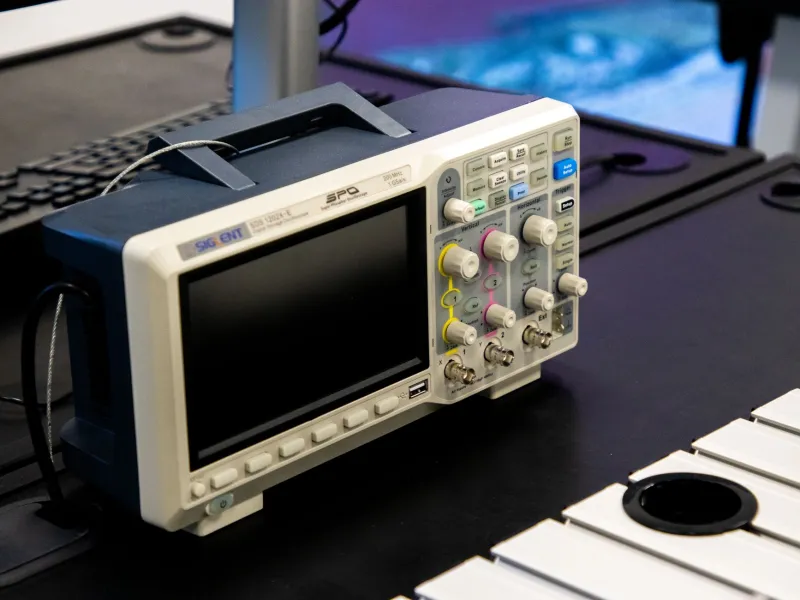
The standard image of a modern recording studio is basically a shrine to the visual. Walls of monitors. DAW timelines that scroll like stock tickers. Plugin windows stacked six deep. Color-coded mixer channels. Everything assumes you've got two working eyes glued to a screen, chasing waveforms across a grid like some kind of sonic spreadsheet.
But a growing number of underground producers — many of them working in the experimental, psychedelic, and noise-adjacent spaces that LSD Muzic lives for — are building studios that throw that whole paradigm out the window. They're blind or have low vision, and instead of adapting to a sighted industry's workflow, they've gone ahead and invented their own. The results are not just functional. They're genuinely visionary.
The Screen Was Never the Point
Here's a thing most sighted producers don't realize: the screen doesn't make the music. It never did. The waveform display, the visual EQ curve, the color-coded arrangement view — those are all representations of sound, not sound itself. They're maps. And as anyone who's ever gotten beautifully lost will tell you, the map is not the territory.
Blind producers know this in their bones. When you can't rely on a visual interface, you develop a relationship with audio that's fundamentally more direct. You're not reading the music — you're inside it.
Producers working in this space talk about building what some call "ears-first" studios, rigs where every decision about gear, layout, and workflow starts with one question: what does this feel like, and what does it sound like? Not what does it look like on a screen.
Hardware Over Software, Touch Over Click
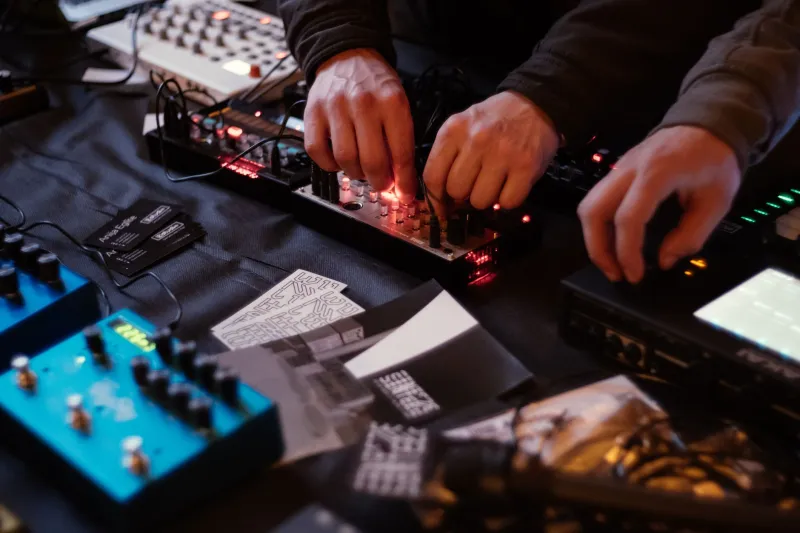
One of the biggest shifts in blind-producer studio design is a move away from mouse-driven software and toward tactile, physical hardware. Modular synthesis is a natural fit here — patch cables are inherently tactile objects, and the relationship between signal and sound is immediate in a way that clicking through menus simply isn't.
Some producers have gone deep into Eurorack setups where every module has a distinct physical profile. Knobs of different sizes and shapes. Switches with clear mechanical feedback. Patch points arranged in spatial patterns that can be memorized and navigated by touch alone. The studio becomes a kind of three-dimensional instrument you learn the way you learn a room in your own home — through repetition, muscle memory, and spatial awareness.
Others have built hybrid rigs that combine hardware synths with highly customized DAW setups made accessible through screen readers and keyboard shortcuts. Reaper, for instance, has developed a reputation in the blind music community as one of the most accessible DAWs around, largely because of its deep keyboard shortcut customization and compatibility with screen reader software like NVDA and JAWS. It's not a glamorous story — it doesn't involve some visionary tech company swooping in — it's a community figuring things out, sharing knowledge, and building workarounds where the industry left gaps.
Spatial Memory as Studio Design
What strikes you when producers in this space describe their setups is how much thought goes into the physical geography of the room itself. Sighted studios are often designed around sightlines — where can you see the screen from? Where's the sweet spot for the monitors relative to your eyes and the display?
Ears-first studios get designed around a completely different logic. Where does the sound land in the room? How does the acoustic space behave? What's the tactile map of the gear layout? Some producers describe arranging their equipment in concentric zones — primary instruments within arm's reach, secondary gear a half-step further, utilities and utilities at the edges — all navigable without looking, all committed to muscle memory.
This kind of intentional spatial design produces studios that are, honestly, acoustically superior to a lot of visually-optimized rooms. When you're not worried about where the monitor is relative to your eyes, you can focus entirely on where it is relative to your ears. Acoustic treatment gets prioritized. Room modes get addressed. The listening position becomes genuinely sacred.
The Psychedelic Dimension
There's something deeply resonant about this approach for anyone who's ever chased altered states through music — which, let's be honest, is most of the people reading this.
A lot of psychedelic and experimental music is trying to get listeners out of their heads and into pure sensory experience. It's trying to dissolve the analytical, visual, map-reading part of the brain and replace it with something more immersive and embodied. Blind producers aren't trying to get there — they're already there. Their whole workflow is built on sensory immersion rather than visual abstraction.
When you hear experimental producers talk about trying to make music that "doesn't sound like it was made on a computer" — that has no seams, no grid-quantized sterility — blind producers working in tactile, hardware-heavy environments are solving that problem structurally. The music sounds different because the process is different.
What the Industry Gets Wrong
The mainstream music tech industry has been pretty bad at this, full stop. Most major DAW developers treat accessibility as an afterthought. Plugin developers are even worse — try navigating a lot of popular VST interfaces with a screen reader and you'll find yourself in a wall of unlabeled buttons and graphical controls that assistive technology simply cannot parse.
This is a failure of imagination as much as a failure of design. The assumption baked into most music software is that the user is sighted, and that visual feedback is the primary channel of communication between producer and tool. That assumption shuts people out, and it also — this is the part that should sting a little — produces worse software. When you design for accessibility, you design for clarity. You design for directness. You design for things that actually matter.
Some smaller developers and open-source projects are doing better. The modular community, with its emphasis on physical interaction and tactile feedback, has produced gear that's often more accessible by accident than commercial software is by design.
The Studio as Instrument
What blind and low-vision producers are really doing — when you zoom out — is treating the studio itself as an instrument. Not a workspace. Not a tool. An instrument, with a physical presence and a learned vocabulary of touch and sound.
That's a radical idea. And it's one that sighted producers could stand to borrow. Because the screen has become a crutch, and the waveform display has become a substitute for actually listening. The visual layer mediates between the producer and the music in ways that are so normalized we don't even notice them anymore.
These producers notice. And they've built something in response — studios that are quieter, more spatial, more tactile, and in a lot of ways, more honest.
Tune in. Drop the screen. Turn it up.