Junk Heap Frequencies: The Underground Economy Turning Dead Synths Into Living Gold
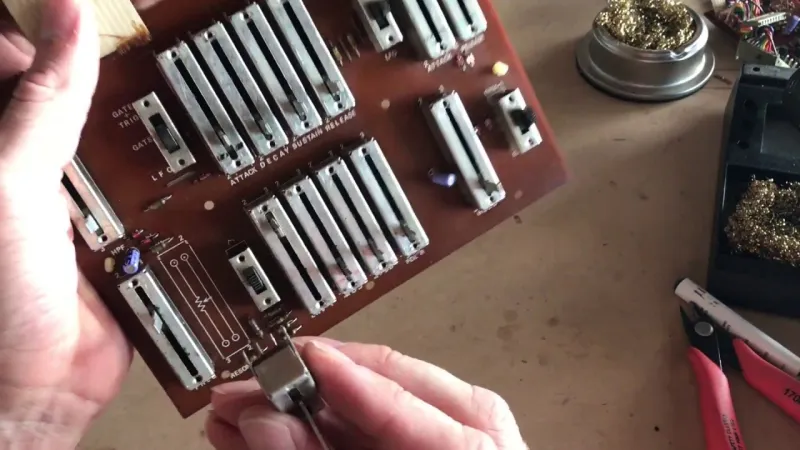
Photo: broken vintage synthesizer circuit board repair workshop, via i.ytimg.com
Somewhere in a Phoenix storage unit, a Roland TR-808 sits with a busted accent circuit that makes every hi-hat sound like it's being played inside a collapsing star. Its owner, a producer who goes by Veldt Null, paid $40 for it at an estate sale. He's turned down $1,200 offers. He says the damage is irreplaceable.
That's the logic — if you can call it logic — driving one of the more fascinating subeconomies in American underground music right now. Broken synthesizers, malfunctioning drum machines, and corroded vintage electronics are being traded, salvaged, and deliberately misused by a loose network of experimental producers who believe that failure, real catastrophic electronic failure, is the most interesting sound design tool available.
The Graveyard Shift
Thrift stores, estate sales, Craigslist listings marked "not working / for parts" — these are the hunting grounds. The community has its own informal pipeline. Facebook groups with names like Dead Gear Lives and Broken Signal Exchange move dozens of units a week. eBay's "for parts or not working" filter has become something of a sacred text for this crowd.
What they're looking for isn't fixable, necessarily. A Korg MS-20 with a cracked filter chip produces a particular kind of tonal instability that no intact unit can replicate. A Juno-106 with failing voice chips drops random notes mid-sequence, turning programmed patterns into something genuinely unpredictable. A Casio with a failing oscillator drifts in pitch according to its own internal weather system.
"People keep trying to fix things that shouldn't be fixed," says Maren Olesk, a Chicago-based sound artist who runs repair workshops out of a shared studio space in Pilsen. "But I'm not interested in restoration. I'm interested in what the machine is trying to say when it's sick."
Olesk's workshops aren't exactly repair classes. They're more like guided conversations with malfunctioning electronics — participants learn just enough about circuit theory to understand what's breaking, then make deliberate decisions about whether to fix it, leave it, or push the damage further.
The Ethics of the Heap
There's a real environmental argument embedded in all of this, even if the participants are usually too deep in sonic philosophy to lead with it. E-waste is a genuine crisis. Americans discard roughly 6.9 million tons of electronics annually, and the global recycling infrastructure for consumer electronics remains deeply inadequate.
The broken gear community functions as an accidental upcycling network. Gear that would otherwise end up shredded for metal recovery — releasing toxic materials in the process — gets routed back into creative use instead. A dead Yamaha DX7 that can't hold its patches anymore becomes a drone machine. A Roland Space Echo with a degraded tape loop becomes an unpredictable reverb unit with a personality disorder.
"Nobody's saving the planet by buying a broken Juno," admits Portland producer Sable Crane, who has built an entire live performance setup from non-functional gear. "But I'm definitely keeping things out of the landfill. And I'm making sounds that don't exist anywhere else on Earth."
The ethics get more complicated in the repair community itself, where debates rage over whether certain vintage pieces should be restored to factory condition instead of being modified or "damaged further." Purists and salvagers don't always get along.
What Broken Actually Sounds Like
If you've never heard a synthesizer with a failing power supply, you're missing a specific kind of beauty. Voltage sag introduces pitch instability that breathes. Corroded potentiometers introduce noise floors with texture. Failing filter chips create resonance peaks in places the designers never intended.
Some of the most distinctive sounds in contemporary experimental music come directly from this kind of malfunction. Artists in the noise, ambient, and psychedelic electronic spaces have been mining broken gear for decades — but the current moment feels different. The community is larger, more organized, and more philosophically explicit about what it's doing.
Los Angeles producer Theo Strand has released three albums recorded exclusively through a chain of malfunctioning gear — a blown-out ARP 2600, a Buchla module with a cracked PCB, and a cassette deck with warped transport rollers. The result is dense, alien, and completely unrepeatable. "I can't play the same show twice," he says. "The machines decide what they're doing that night."
That unpredictability is the point. In a production landscape saturated with sample packs, VST plugins, and the relentless precision of digital audio workstations, broken hardware introduces genuine chaos — the kind that can't be programmed or downloaded.
The Price of Failure
Here's the irony the market has created: broken gear is getting expensive. As word spreads about the sonic potential of malfunctioning electronics, demand has started outpacing supply. That $40 estate sale TR-808 with the busted accent circuit? Similar units have been quietly trading for several hundred dollars in the right circles.
"The secret's out," says Olesk, with some frustration. "Three years ago I could find interesting broken stuff for nothing. Now people know what they have, or they think they do."
There's also a growing market for deliberately damaged gear — units that have been modified to malfunction in specific, repeatable ways. It's a strange paradox: paying someone to carefully break something so that it breaks interestingly. The line between damage and design blurs completely.
For the true believers, though, the philosophy remains intact regardless of price. Sound that can't be copied, can't be uploaded, can't be algorithmically served to a playlist — sound that lives only in the specific, irreproducible failure of a specific machine — that's worth something money can't quite measure.
Veldt Null is still turning down offers on that 808. The collapsing-star hi-hat isn't for sale. Some sounds are too broken to give up.