Resurrection Men: The Obsessive Synth Salvagers Pulling the 1970s Back From the Brink
Somewhere in a storage unit outside Tulsa, Oklahoma, there's a Minimoog Model D sitting under a tarp next to a broken lawnmower and three boxes of Reader's Digest condensed books. It's been there since 1987. The family that owns it has no idea what it is. They priced it at forty bucks.
That's the world these people live in.
The synth salvagers — call them collectors, call them obsessives, call them whatever you want — are a decentralized, loosely coordinated underground network operating across every state in the country. They haunt estate sale apps at 2 a.m. They have standing relationships with pawn shop owners in places like Shreveport and Billings and Gary, Indiana. They drive six hours on a Sunday because someone posted a blurry photo on Facebook Marketplace of something that might be an ARP Odyssey behind a water heater.
Most of the time, it's nothing. Sometimes, it's everything.
The Graveyard Shift
To understand why any of this matters, you have to understand what happened to synthesizers in the 1980s. When digital synths — the Yamaha DX7, the Roland D-50 — hit the market, they were cheaper, more reliable, and didn't need constant tuning. Suddenly, the massive, temperamental analog beasts of the previous decade felt obsolete. Bands unloaded them. Studios sold them for pennies. Some went into closets. Some went to Goodwill. Some, genuinely, went to landfills.
The machines that survived are now worth thousands, sometimes tens of thousands, of dollars. But the ones still hiding in plain sight? Those are the holy grail.
Denver-based salvager Marcus Trell — who asked us not to use his last name because, as he put it, "I don't need more competition" — has been hunting for about twelve years. He's pulled an Oberheim OB-Xa from a flooded basement in Columbus, a working EMS Synthi AKS from a deceased professor's office at a small college in Vermont, and what he believes is a prototype unit from a company that went bankrupt in 1979, identity still unconfirmed.
"People think of these as antiques," he says. "They're not antiques. They're instruments. There's a difference. An antique sits in a case. An instrument wants to be played."
What Gets Thrown Away
The stories are wild, and they're real. A first-generation Buchla Music Easel — a machine that Buchla himself built in limited numbers for the San Francisco Tape Music Center — turned up at an estate sale in Marin County a few years back, priced at $200 because the family assumed it was "some kind of old radio equipment." A Sequential Circuits Prophet-5, one of the most important polyphonic synthesizers ever made, was found in a trash pile outside a recording studio in Nashville that was being renovated.
These aren't anomalies. They're the norm. The gap between what these machines are and what the general public thinks they are remains enormous, and that gap is what keeps the salvagers in business.
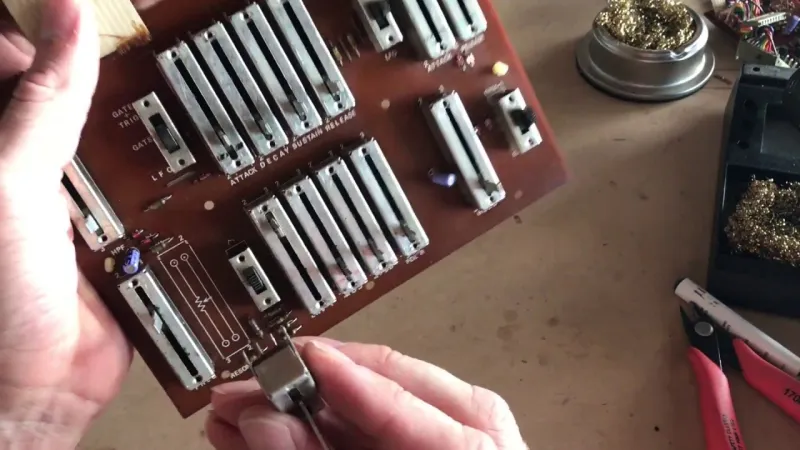
Chicago-based restorer and musician Yael Okonkwo focuses specifically on instruments that have suffered water or fire damage — the ones that other collectors won't touch. Her workshop in Pilsen looks like a very organized disaster: oscillator boards drying on racks, pots soaking in contact cleaner, a wall of replacement capacitors organized by value.
"The damage tells you something," she explains. "A synth that got wet in a flood in someone's basement — that means it was loved enough to be kept somewhere, even if that somewhere wasn't great. The ones that break my heart are the ones that come in clean. That means they were just... forgotten."
Okonkwo restores roughly eight to twelve instruments a year, keeping some, selling others to working musicians, and occasionally donating to arts programs. She charges for labor but never inflates prices based on collector market values. "These should be in studios, not display cases," she says flatly.
How the Network Works
There's no app for this. No central registry. The network runs on text threads, Discord servers with invite-only access, and old-fashioned word of mouth. Someone spots a lead, puts it into the group, and whoever's closest or most motivated makes the move. There's an informal code: if you tip someone to a find, you get a cut of goodwill, maybe a component you've been looking for, maybe just the knowledge that the favor will be returned.
The community skews heavily toward musicians who actually use what they find. That's a point of pride. These aren't flippers chasing resale value on Reverb. Most of the salvagers we spoke to have strong opinions about instruments ending up in working rigs rather than climate-controlled collections.
"There's a guy in Phoenix who buys everything and plays nothing," says Trell, with barely concealed contempt. "We don't really talk to him."
The Sound of the Saved
Here's where it gets interesting from a pure music standpoint: the instruments being rescued are actively reshaping what experimental and underground music sounds like right now. The warmth, instability, and character of vintage analog circuits — especially ones that are slightly degraded, slightly out of spec — produce sounds that no plugin has ever successfully replicated.
Producers in the hypnagogic pop, noise, and experimental ambient scenes are particularly hungry for this stuff. A Korg PS-3300 with a failing filter sounds like nothing else on earth. An ARP 2600 with a flaky keyboard produces accidental pitch variations that can make a whole track feel alive in a way that perfect digital synthesis never does.
Okonkwo plays in two projects — a drone duo and a solo modular set — and she uses restored instruments exclusively. "The imperfection is the point," she says. "These machines have history in them. You can hear it."
Trell recently completed a full album recorded using only instruments he's salvaged over the past decade, released on a limited cassette run through a small label in Portland. The liner notes list each synth's origin story. The Oberheim from the flooded basement. The mystery prototype. A Moog Satellite found at a Salvation Army in Albuquerque for eight dollars.
Eight dollars.
The Stakes
The window is closing. As awareness grows — fueled partly by YouTube restoration channels, partly by the skyrocketing market for vintage gear — the easy finds are getting rarer. Estate sale companies are getting smarter. Pawn shops are doing Google searches before they price things. The days of stumbling onto a Prophet-5 for two hundred bucks are mostly over.
But the salvagers aren't stopping. Because for every find that makes the legend, there are fifty more machines out there in storage units and attics and the back rooms of shuttered music shops, waiting. Degrading slowly. Losing capacitors to age. Getting closer to genuinely gone.
Someone has to go get them.
"Every one of these machines that gets saved," Okonkwo says, pulling a recapped oscillator board from a drying rack, "is a sound that didn't disappear. That matters. That's real."
She plugs the board in. Something hums. Something wakes up.
Somewhere in Tulsa, that Minimoog is still under a tarp.